A Beginner's Guide to Framing Pictures
You have a picture you want to display. The next step is to work out its size, choose a frame and decide whether it needs a mount. You do not need to know all the specialist terminology to get started.
This guide takes you through ordering a frame for flat photographs, prints and paper artwork. Canvas, deep objects and fragile originals can need a different approach, so get advice before ordering for those.
Check what you are framing
Lay the picture on a clean, dry surface and look at the whole sheet. Does it have a white border? Is there a signature near an edge? Do you want all of the paper visible, or just the image?
Those details matter because the front edge of a frame, or a mount opening, normally overlaps part of the artwork. If a signature, caption or important feature sits close to the edge, contact us before choosing the size. Do not trim the picture to make a frame fit.
If the photograph is still a digital file, you can instead choose Print & Frame with an Any Size frame. Upload the original image on the frame's product page and review its size and crop before adding it to your basket.
Measure the full width and height
For a physical print, measure the full sheet from edge to edge. Keep the ruler straight, record width first and height second, and write down the units. Millimetres are useful when a print does not match a standard size exactly.
For example, a portrait A4 sheet is 210mm wide and 297mm high. Enter 210 × 297mm as the artwork size in our made-to-measure designer. Do not add extra width for the frame or a proposed mount: the designer works those out from your selections.
Use the actual print rather than a remembered paper size. A photograph's image area, paper dimensions and a photographer's package name are not always interchangeable.
Decide whether a ready-made or custom frame suits you
A ready-made frame is a straightforward option when its stated picture size matches your artwork and you like the supplied combination of frame, mount and glazing. Check whether the product lists the frame size, the size held with a mount, or both.
A made-to-measure frame gives you more control over the dimensions and finish. It is useful for unusual print sizes, wider mount borders or a particular look you cannot find in a standard frame.
Neither choice requires you to have a digital image. If your artwork is already at home, you can simply order a frame to fit it.
Choose a mount, or leave it out
A mount is the card border between the picture and the frame. It can give a small image more presence, separate the picture visually from a strong frame colour and help create a consistent look across a collection.
Start by comparing the picture with and without a simple neutral mount. Then consider the border width and colour. Remember that a wider border increases the finished frame size.
Our complete made-to-measure frame designer allows for 4mm of overlap on each edge when you add a mount. Enter the full artwork dimensions; do not subtract that overlap yourself.
Buying only a mount for an existing frame? That is a different measurement task. The mount designer asks for the exact opening you want cut and the outside size that fits inside your frame. Measure the existing glass or backing for that outside size, rather than the front edge of the frame, and follow the opening-size guidance shown there.
Compare the frame colour and width
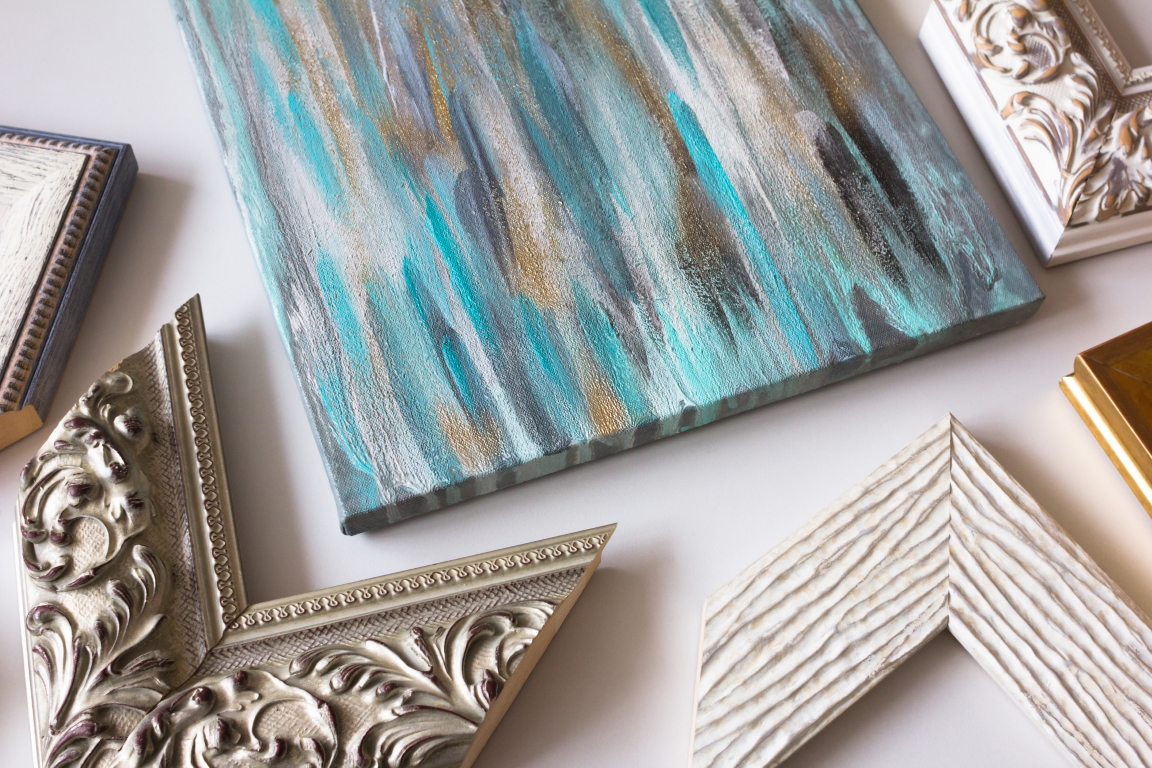
Choose a finish that works with the picture, then consider the room. A slim black frame can define the edges of a pale print; natural wood may pick up warmer tones; a wider profile can give a simple composition more weight.
Check the whole combination, including the mount. Changing the border can make the same frame feel quite different. If you are planning a pair or a gallery, note the outside frame dimensions as well as the artwork sizes.
A paper template of the finished size is a useful final check on the wall. It is easier to move paper around than discover after hanging that the frames do not fit the space as expected.
Review glazing and display options
Read the options offered for your chosen product. Glazing is the clear covering in front of the picture. Consider weight, reflections and care requirements, and check separately for any stated UV-filtering specification.
For valuable originals or delicate surfaces, get specialist advice rather than treating standard framing options as conservation protection. Our six things to know about framing explains these distinctions.
If the frame is for a shelf, confirm it has a suitable stand. If it is for a wall, check the hanging arrangement and plan fixings for the frame's weight and the wall material.
Make a final check before ordering
- Size: the width, height and units match the artwork you measured.
- Orientation: portrait and landscape are the right way round.
- Visible details: signatures, captions and faces will not be hidden by the mount or frame.
- Options: the mount, glazing, frame finish and quantity are correct.
- Printing: you have selected it only if you want us to print a digital photo, and have checked the crop.
- Placement: the outside dimensions and display method suit the intended space.
When the frame arrives, follow its fitting and care instructions. Keep important paper artwork out of direct sunlight and away from damp or strong heat. If you are unsure about hanging it securely, use a professional picture hanger.
Ready to explore the options? Start with your artwork measurements in our frame designer and build the combination around your picture.